A Data-Driven Future:
AI Opening the Door to Personalized Medicine for Chronic Low Back Pain

In medicine, the ideal of providing “the right treatment for each individual” has long been held up as a goal worth pursuing. In practice, however, achieving that goal has never been straightforward. Every patient comes with a different background, different symptoms, and a different response to treatment. Making sense of these differences in an integrated way, and then identifying the most suitable treatment, requires not only a large volume of data but also analytical tools sophisticated enough to uncover meaningful patterns within it.
This time, we will introduce a case study showing how Multi-Sigma® can be applied to personalized care for patients with chronic low back pain. The data presented here are synthetic data created for educational and demonstration purposes. Accordingly, the purpose of this article is not to present specific medical findings, but rather to illustrate a methodology for treatment optimization based on AI.
Chronic low back pain: A major challenge in modern society
Chronic low back pain is one of the most common health concerns in modern society, and its impact on quality of life can be substantial. Although a wide range of treatment options is available, the same approach does not work equally well for every patient.
For some individuals, exercise therapy may bring meaningful improvement, while for others, drug therapy may lead to better results. The aim of this analysis using Multi-Sigma® is to support the realization of personalized medicine that takes these individual differences into account.
Using a neural network to better understand treatment response in chronic low back pain
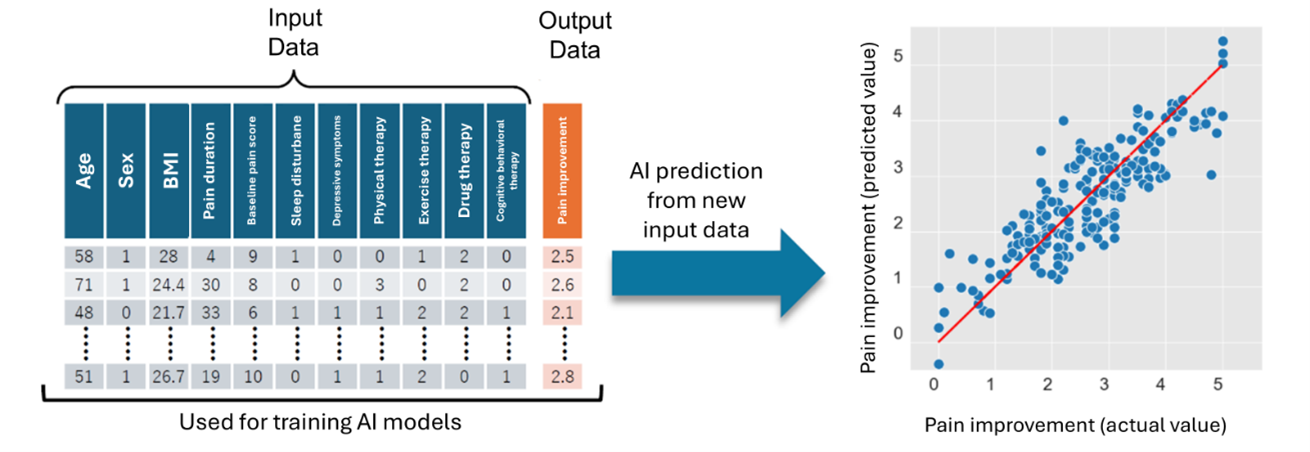
For this analysis, a neural network model was built using data from 800 patients with chronic low back pain. This AI model is particularly well suited to identifying complex patterns hidden within the data. The following items were used as the model’s input data (or explanatory variables):
- Patient attributes: age, sex, body mass index (BMI), and duration of pain (months)
- Symptom indicators: baseline pain visual analogue scale (VAS) score (5-10), presence/absence of sleep disturbance, and presence/absence of depressive symptoms
- Treatment details: frequency of physical therapy (sessions per week), intensity of exercise therapy (0-2), drug therapy (none/nonsteroidal anti-inflammatory drugs [NSAIDs]/ non-NSAID analgesics), and whether cognitive behavioral therapy was provided or not
The output data (or objective variable) were defined as the degree of improvement in the pain VAS score (0-5). The VAS score is a measure used to express the intensity of pain a patient feels on a scale from 0 (meaning no pain) to 10 (meaning the worst pain imaginable).
Three innovative analytical capabilities enabled by Multi-Sigma®
1. Predicting treatment response with high accuracy
Using Multi-Sigma®’s predictive capabilities, a neural network model was developed that can estimate the degree of pain improvement for new patients with a high level of accuracy based on their clinical data. This makes it possible to estimate likely treatment outcomes before therapy begins, allowing both patients and healthcare providers to share more realistic expectations from the outset.
When the model was tested on a separate dataset of 200 patients, the predicted values showed a strong correlation with the observed degree of improvement, indicating good agreement within this synthetic demonstration setting. If applied to real clinical data, this kind of predictive framework could help make treatment planning more evidence-based and give clinicians a more informed view of likely outcomes from the start.
2. Revealing what influences treatment outcomes through “Contribution Analysis”
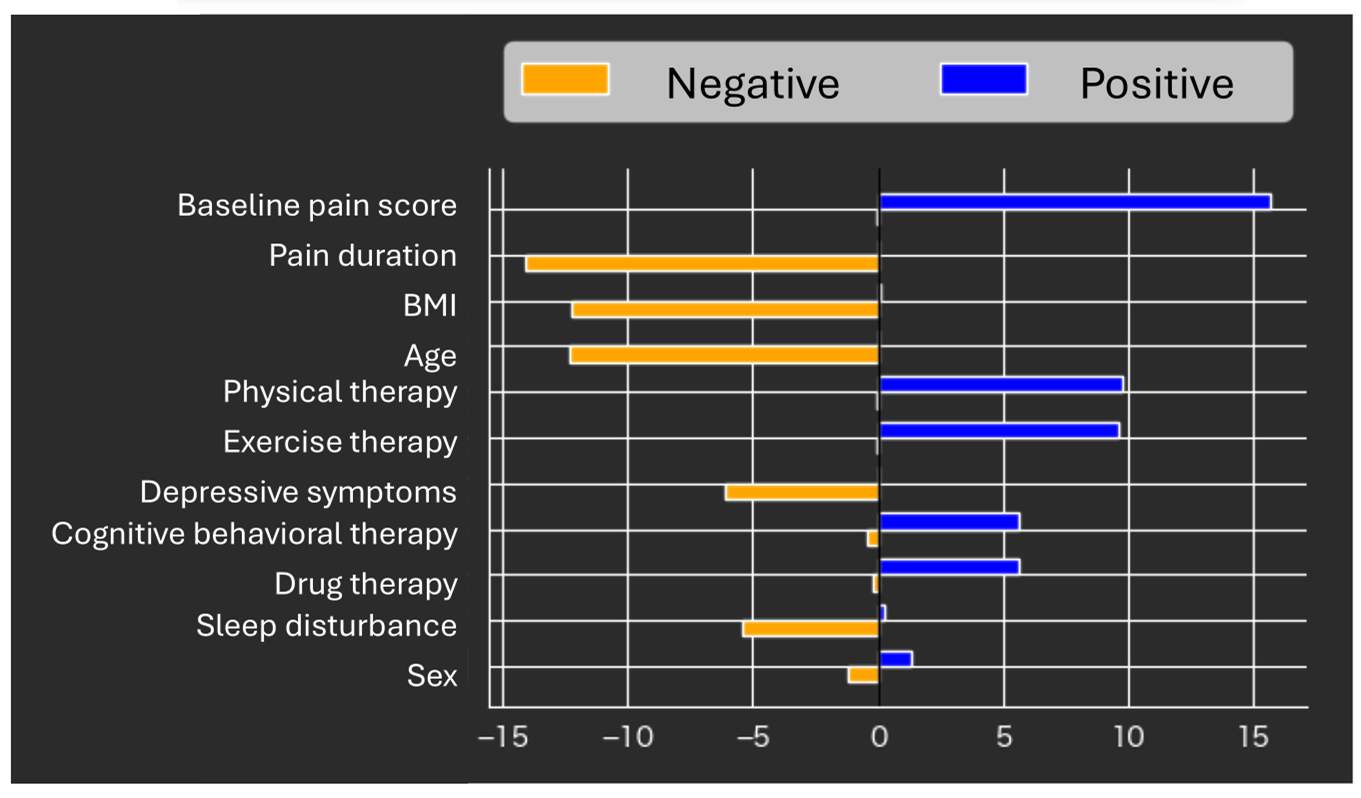
Multi-Sigma®’s Contribution Analysis function was also used to visualize how strongly each variable contributed to pain improvement. In this case, several clear patterns emerged:
Factors associated with positive improvement:
- more frequent physical therapy
- an appropriate level of exercise therapy intensity
- the use of cognitive behavioral therapy
- selection of an appropriate drug therapy
Factors associated with negative improvement:
- pain that has continued for a long period
- higher BMI
- older age
- the presence of depressive symptoms
- the presence of sleep disturbance
When applied to real clinical data, this kind of analysis can offer a more objective view of which factors are shaping treatment outcomes. That, in turn, can provide a stronger scientific basis for building treatment strategies in actual clinical settings.
3. Personalized treatment planning through “Tailored Optimization”
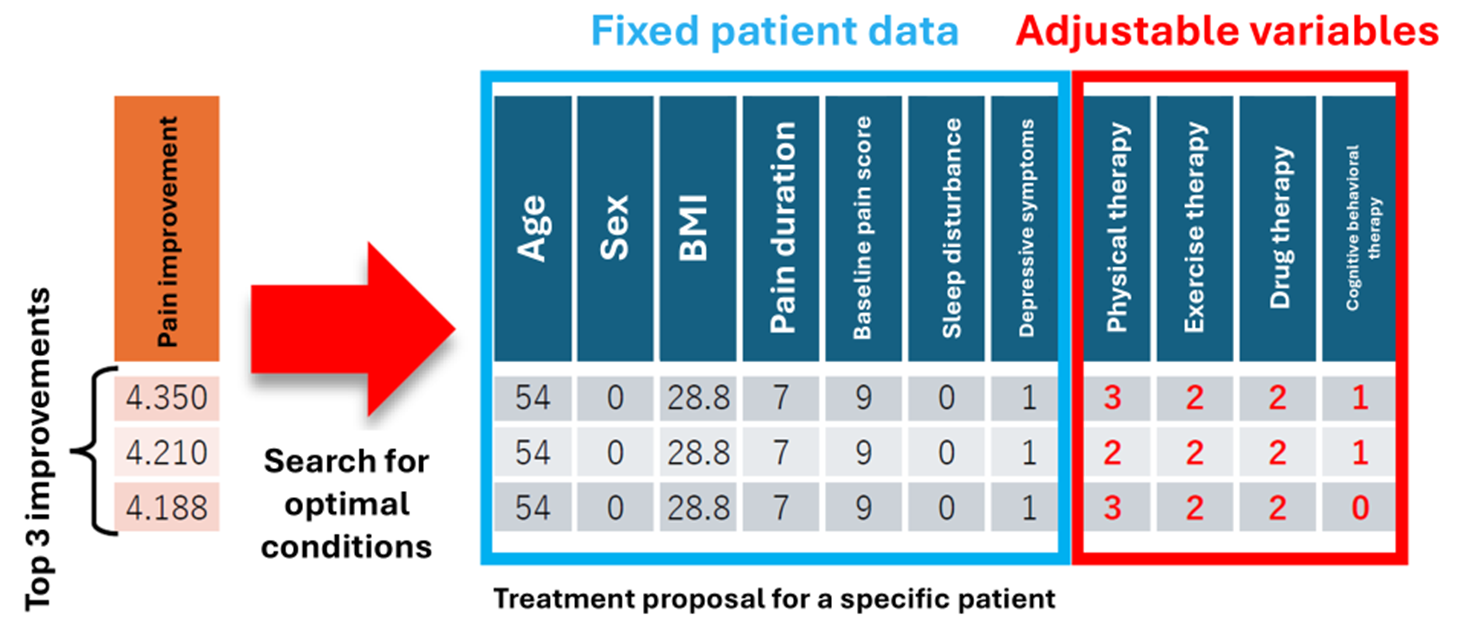
One of Multi-Sigma®’s most powerful features is its tailored optimization capability, which can propose the most appropriate treatment plan for each individual patient.
What makes this function especially appealing is how simple the process is. Exploring an optimized treatment strategy for a specific patient can be done in just a few straightforward steps:
1. Open the optimization screen in Multi-Sigma®.
2. Enter the patient’s fixed attributes and symptoms:
- For patient-specific factors that cannot be changed, such as “Age”, “Sex”, “BMI”, “Pain duration”, “Baseline VAS score”, “Sleep disturbance”, and “Depressive symptoms”, the same actual value is entered as both the minimum and maximum.
- For example, if the patient is 60 years old, both the minimum and maximum values for age are set to “60”.
3. Set the value range for treatment options:
- For treatment-related variables that can be adjusted, such as frequency of “Physical therapy”, intensity of “Exercise therapy”, “Drug therapy”, and “Cognitive behavioral therapy”, the full range of possible values is entered.
- For example, if physical therapy frequency can vary from 0 to 3 sessions, the minimum is set to “0” and the maximum to “3”.
4. Simply click the “Optimize” button, and Multi-Sigma® automatically calculates the combination of treatment options most suited to that patient.
For example, when data for a 54-year-old male patient was entered:
- BMI: 28.8
- Pain duration: 7 months
- Baseline VAS score: 9
- Sleep disturbance: none
- Depressive symptoms: present
the following treatment plan was identified as the optimal solution:
- Physical therapy: 3 sessions per week (the highest frequency)
- Exercise therapy: high intensity (Level 2)
- Drug therapy: non-NSAID analgesics (Level 2)
- Cognitive behavioral therapy: required
For this combination, the improvement in VAS score was approximately “4.35”. This is higher than the average improvement value of “2.54” across the treatment plans in the synthetic dataset.
This example illustrates how AI-based optimization can generate a treatment plan that reflects the characteristics of an individual patient, rather than using the same approach for everyone. At the same time, the reliability of such predicted values ultimately needs to be established through comparison with real clinical outcomes.
Broader potential applications of the optimization approach
The optimization approach demonstrated here with Multi-Sigma® has potential applications not only in healthcare, but across a wide range of other fields as well. A few possible examples are introduced below:
1. Optimizing product quality in manufacturing
In the manufacturing sector, a similar approach can be used to improve product durability. For example, an automotive parts manufacturer could apply this type of optimization to identify better production conditions for any given product.
Fixed variables (conditions that cannot be adjusted):
- the type of material used
- size constraints of the product
- the upper cost limit
Optimization variables (conditions that can be adjusted):
- manufacturing temperature
- applied pressing pressure
- cooling time
- surface treatment method
By automatically identifying the manufacturing parameters best suited to a product under a specific set of material and size constraints, this approach can help improve durability in a targeted and efficient way.
2. Optimizing crop yield in agriculture
In agriculture, optimization methods could also be introduced to improve wheat yield. For example, an agricultural company could use this approach to determine the most suitable growing conditions for a particular field and crop variety.
Fixed variables:
- climate conditions in the cultivation area
- basic soil characteristics
- wheat variety
Optimization variables:
- irrigation volume and frequency
- type and amount of fertilizer
- sowing density
- harvest timing
This makes it possible to identify the growing conditions best suited to a particular wheat variety in a particular field, with the aim of improving overall yield.
3. Portfolio optimization in finance
In the financial sector, this approach could also be applied by investment advisory firms to design asset allocations tailored to each individual client.
Fixed variables:
- the client’s age
- risk tolerance
- investment goals (such as education funding or retirement planning)
- investment period
Optimization variables:
- allocation to equities
- allocation to bonds
- allocation to real estate investments
- rebalancing frequency
With this kind of individualized optimization, it becomes possible to build a portfolio designed for that specific client, with the potential to improve returns while keeping risk under control.
4. Learning plan optimization in education
A similar approach could also be adopted in education. For example, online learning platforms could use it to improve learning efficiency for each student by tailoring study plans more precisely to individual needs.
Fixed variables:
- the learner’s age
- current academic level
- available study time
- learning goals
Optimization variables:
- type of learning content (such as video, text, or interactive material)
- length of each study session
- review timing
- how quickly the difficulty level is increased
This makes it possible to automatically generate a learning plan suited to a particular student, with the potential to achieve a higher level of understanding even within the same amount of study time.
The future of healthcare shaped by AI-driven analysis
This case study using Multi-Sigma® offers a glimpse of what AI and data analysis could bring to healthcare. Although this particular example is based on synthetic data, applying the same methodology to real clinical data could move us closer to truly evidence-based personalized medicine.
What is especially noteworthy here is that the approach goes beyond simple prediction. It also makes it possible to move toward actual treatment optimization. In other words, it opens the door to a shift away from treatment decisions based primarily on experience or broad general guidelines, and toward care plans that are better tailored to the needs of each individual patient.
Optimization technologies of this kind have potential well beyond healthcare and could be applied across many industries. Even so, their significance in medicine is particularly profound, because optimizing care at the individual level has the potential to directly improve patients’ quality of life.
Looking ahead, we hope that continued collaboration between clinical experts and data scientists will further expand the use of platforms such as Multi-Sigma® in real-world settings. Above all, we hope that efforts like these will help ease the burden of chronic low back pain for many patients and contribute to a better quality of life.
Note: This analysis is based on synthetic data, and in actual clinical practice, decisions must be made in accordance with the relevant guidelines.






機械学習を使った分析や予測が日常的に行われる今、協調フレームとしてのMulti-Sigma®の役割は増すばかりです。
『どのような場面で活用できるのか』をもっと知りたい方や、実際の利用シーンを見てみたい方は、是非一度お気軽にご相談ください。
In a world where machine learning-based analysis and prediction are becoming everyday practices, the role of Multi-Sigma® as a collaborative framework is more crucial than ever.
If you're interested in learning more about how it can be applied or want to see real-world examples, feel free to contact us.