From Simulation to Smarter Design: AI × CAE, Surrogate-Model Optimization, and a Real-World Case Study
1. Introduction: How CAE is transforming manufacturing and where the challenges remain
In today’s world of product development, there is a growing need to bring important product-design evaluation and decision-making activities into the earliest stages of the process, an approach referred to as “front-loading”. The reason is simple: the more accurately engineers can assess a design before physical prototypes are built or experiments are conducted, the more effectively they can shorten development timelines and reduce costs. At the center of this shift are simulation technologies such as CAE (Computer-Aided Engineering).
By allowing fluid behavior, structural performance, electromagnetic fields, and other physical phenomena to be analyzed in a digital environment, CAE has become indispensable to modern product design. Engineers can now evaluate everything from the lift characteristics of an aircraft to the crash safety of an automobile in considerable detail, even at an early stage and before physical testing begins.
However, CAE also comes with very real practical constraints. The simulation of large-scale unsteady fluid phenomena around aircraft wings or vehicles, or the reproduction of the complex deformation that occurs during a collision, typically demands enormous amounts of computation time and resources. When optimization requires a large number of design conditions to be evaluated, this kind of burden can become so heavy that carrying out such an analysis becomes difficult or, in some cases, simply impractical.
This is why AI-based surrogate models are attracting growing attention. A surrogate model learns from the results generated by CAE and serves as a fast, highly accurate alternative for design exploration. By using such a model, engineers can examine a far wider range of possibilities and expand the feasibility of optimization tasks that would be difficult to perform with CAE alone.
In this blog article, we explore an approach that uses AI to complement the limitations of CAE and push the design process forward. We will also introduce a specific case study using Multi-Sigma®, a no-code AI analytics platform.
2. The limitations of simulation and the challenges of optimization
As CAE expands, its practical constraints become clearer
With improvements in accuracy, CAE has become capable of reproducing increasingly complex physical phenomena, including nonlinear and unsteady behavior. Its range of applications has therefore continued to expand. But this greater analytical power comes at a cost: more demanding calculations and more advanced computing environments are needed now.
As we saw earlier, simulations of complex flow behavior and collision-induced deformation can require anywhere from several hours to several days for just one case. In many situations, these analyses also depend on high-performance computing systems, which means that running large numbers of simulations is not something that can be done easily by everyone.
Why CAE and optimization do not always work well together
Optimization plays a central role in design development: it is used to maximize or minimize a target performance while searching for the most effective design. The difficulty is that dozens of design parameters must be considered at the same time, making it far more challenging to achieve both accuracy and computational efficiency.
The problem grows even more complex when several objectives (such as strength and cost) must be balanced simultaneously. Each candidate design may require another CAE analysis and the number of possible combinations can quickly become overwhelming. In practice, engineers are often forced to narrow the search range or reduce the number of trials. The result may be a “compromise design” or a solution refined largely through the experience of highly skilled specialists.
Why complex design exploration calls for a new approach
The challenge is not simply that CAE calculations are expensive. Modern design problems typically involve several competing goals at once, including performance, cost, and environmental impact. At the same time, the number of design variables can easily rise into dozens, creating a high-dimensional, multi-objective optimization problem that cannot be solved efficiently by simple exhaustive searches.
Advanced optimization methods such as the Multi-Objective Genetic Algorithm (MOGA) are therefore required. Yet they also require a rapidly increasing number of analyses, time and computing resources. At some point, this burden can become so great that continuing the optimization is no longer practical.
CAE is becoming more powerful, but greater analytical capability does not automatically make large-scale design exploration practical. Hence, there is a growing need for a complementary approach to fully leverage that potential.
This is why AI-based surrogate models are attracting increasing attention. In the next section, we will explain how surrogate models work and examine how they can reshape the design process.
3. “AI Surrogate Models” as a practical solution
What does it mean for AI to learn from CAE results?
As discussed in the previous section, exploring designs with high-accuracy CAE can be extremely computationally demanding, which limits how extensively it can be used in day-to-day engineering practice.
One increasingly promising solution is the use of “AI-based Surrogate Models”.
Using machine learning, a surrogate model learns an approximate relationship between the inputs and outputs found in past CAE results. It can then generate predictions at high speed, serving as an efficient alternative to the original full-scale analysis. Depending on the field or the literature, similar models may also be called “Reduced Order Models (ROMs)” or “Meta-models”. Although the terminology varies, these models are gaining recognition for their ability to make design exploration and optimization far more efficient.
Speed and flexibility to accelerate design exploration
Speed is where surrogate models make the greatest difference. Their output predictions can be generated dramatically faster than CAE results, making it realistic to explore a much wider design space than would otherwise be possible.
They prove particularly effective in scenarios such as:
- Predicting outcomes across many evaluation scenarios at once
- Analyzing how individual design variables affect a response through sensitivity analysis
- Combining the model with an optimization algorithm to support design exploration.
Surrogate models can also be combined with Model-Based Development (MBD), allowing them to be used more widely in systems engineering.
Automating surrogate-model development with no-code AI
The challenge is that creating an AI-based surrogate model has traditionally required specialized skills such as knowledge of machine-learning algorithms, along with the ability to choose and configure hyperparameters correctly. Historically, this has been one of the main obstacles to bringing AI into actual design and development work.
Our proposed solution is to automate the surrogate-model development process with Multi-Sigma®.
With this approach, engineers who already understand CAE can take the lead. Even without specialized AI knowledge, they can independently build and operate surrogate models that support their own design work.
In the next section, we introduce Multi-Sigma®, the AI analytics platform developed by our company, and explore the specific functions and technical features behind this approach.
4. What sets the AI analytics platform Multi-Sigma® apart?
A practical no-code environment for bringing AI into engineering
As discussed in the previous section, AI surrogate models can ease the computational burden of CAE and reduce the limitations imposed by repeated analysis, making practical design optimization far more achievable. The challenge is that building these models has typically required specialist knowledge of machine learning, together with the skills needed to adjust and tune numerous parameters. For many engineering teams, this technical barrier has stood in the way of bringing AI into everyday design work.
Multi-Sigma®, our AI analytics platform, is designed to remove that barrier. It provides a single environment in which users can build, evaluate and apply AI models without needing to understand the model’s internal architecture or handle the complexities of tuning it themselves. Its intuitive, GUI-based interface allows design engineers with expertise in CAE to work directly with AI.
Why high-accuracy models can be built from limited data
At the heart of this practical approach lies Multi-Sigma®’s “Automatic Hyperparameter-Tuning function”.
Creating a neural network normally involves adjusting many settings, from the number of hidden layers to the choice of activation function. Multi-Sigma® optimizes these parameters automatically. Users can therefore focus on their data and design objectives rather than on the inner technical details of the AI and can build accurate models even from relatively small datasets, often referred to as “small data”.
This makes the use of surrogate models a realistic option even during the early stages of development, when only a limited number of prototypes or experimental results may be available.
Multi-Objective Optimization: Visualizing the design space and searching for solutions
Multi-Sigma® also supports Multi-Objective Optimization. Using the Multi-Objective Genetic Algorithm (MOGA), it enables the following types of exploration:
- Balancing multiple performance targets (such as strength vs. weight, cost vs. safety)
- Identifying trade-offs between competing requirements
- Deriving and visualizing Pareto-optimal solutions
With CAE alone, evaluating the enormous number of possible combinations created by many design variables can quickly become impractical. By using a surrogate model, Multi-Sigma® makes it possible to analyze these combinations rapidly and comprehensively, providing powerful support for engineering decision-making.
This is the kind of transformation Multi-Sigma® brings to the design process.
Key benefits at a glance
Taken together, these capabilities offer several practical advantages for engineering design:
- Building AI models through intuitive, GUI-based operations
- Generating accurate predictions even from limited datasets
- Carrying out the full process through Multi-Objective Optimization
- Comparing and visualizing results to support design decisions
In the next section, we will introduce a case study that puts these capabilities into practice: the optimization of automotive safety-device design while accounting for occupants with a wide range of body types.
5. Case study: Using AI to optimize automotive safety devices
Background: Why safety design must account for a wider range of conditions
Automotive safety design is increasingly expected to account for the diversity of occupant body types and postures. Today, there is a demand for designs that are globally optimized by comprehensively considering complex conditions that include:
- Older adults, pregnant women, small-statured women, and children
- Differences in sitting posture and seat position
- Multiple collision scenarios (including frontal, side, and oblique impacts).
The difficulty is that evaluating such a broad combination of variables comprehensively with CAE alone is extremely demanding. The number of required analyses can quickly grow, along with the time and effort needed to complete them.
AI-driven solution: Building and optimizing a surrogate model with Multi-Sigma®
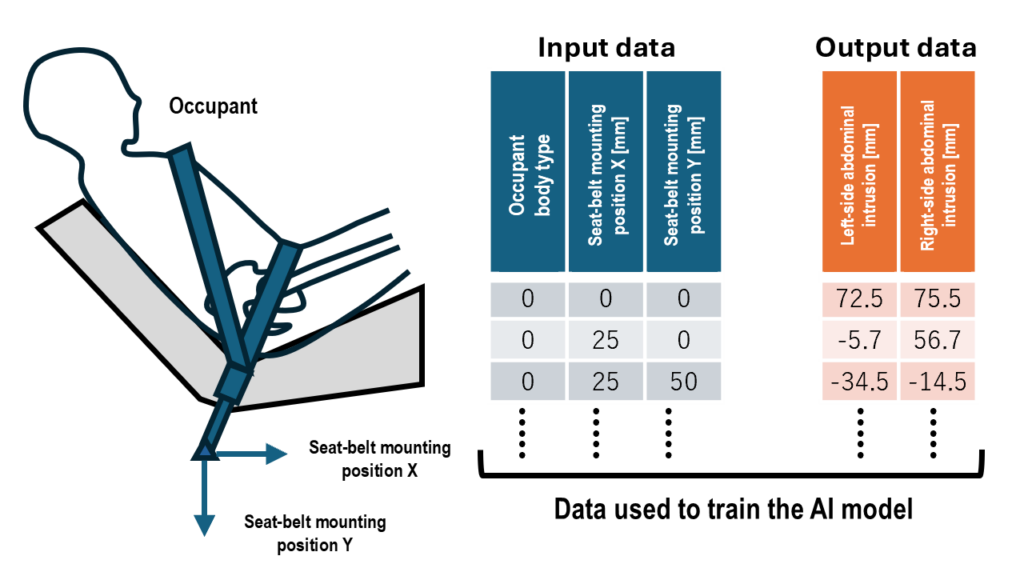
To address this challenge, we used Multi-Sigma® to build an AI surrogate model with good predictive performance overall from a limited set of CAE simulation results (14 cases) and applied it to the optimization of automotive safety design (1).
The analysis focused on small-statured female occupants and adult male occupants seated in a reclined posture, a position that can be unfavorable in terms of abdominal injury during a collision. The aim was to train the model on the corresponding crash-simulation results and derive a design solution for the seat-belt mounting position.
Analysis conditions
Input data
- Occupant body type: small-statured female / adult male
- Seat-belt mounting positions: X and Y
Output data
- Left and right-side abdominal intrusion caused by the seat belt during a collision

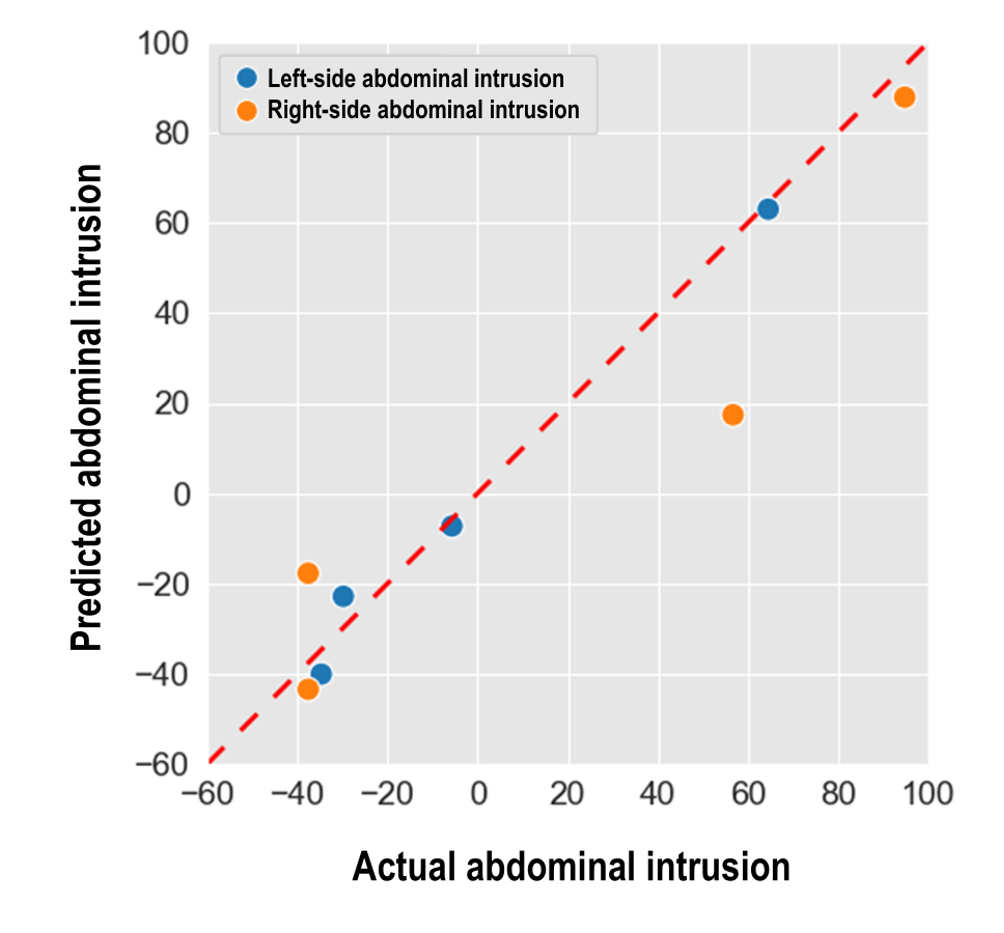
In this case study, we selected a Deep Neural Network (DNN) to construct the surrogate model. However, a DNN is not the only option. When the available dataset is particularly small, Gaussian Process Regression (GPR) can also provide an effective alternative.
Multi-Sigma® makes this option readily accessible: by selecting “Gaussian process regression/Bayesian optimization” as the analysis type, users can build a GPR-based model within the platform. This is particularly useful when working with experimental results or at the prototyping stage, where the amount of available data is often limited.
Despite the relatively small training dataset of just 14 cases, Multi-Sigma®’s Auto-tuning function made it possible to construct a surrogate model with good predictive performance overall.
Contribution Analysis and derivation of the optimal design
The value of the surrogate model extended beyond prediction. Using Multi-Sigma®’s Contribution Analysis function, it was also possible to examine the model’s results and determine which factors had the greatest influence on injury risk during a collision.
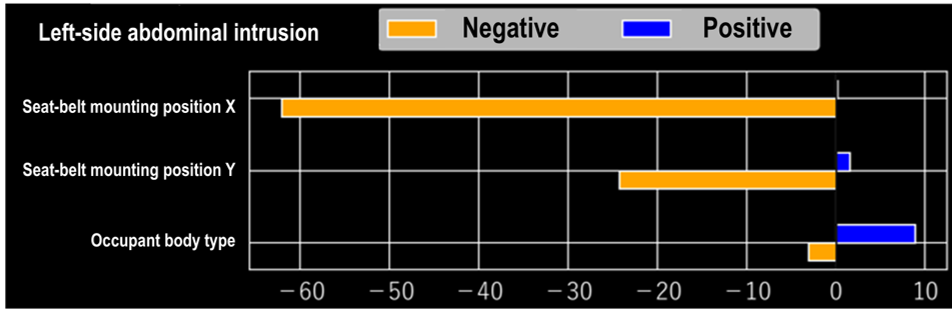
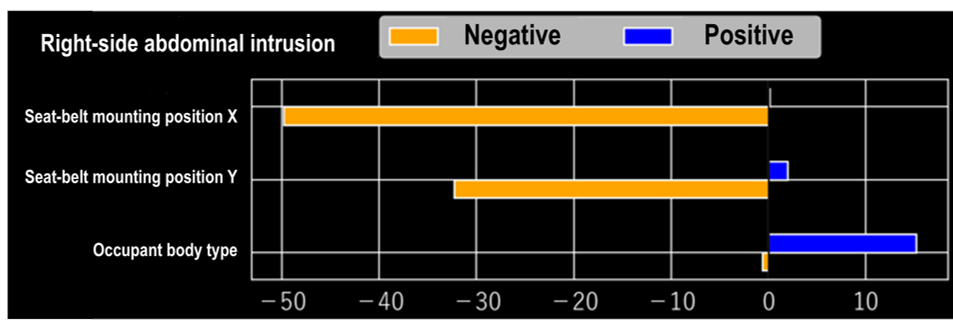
Two findings stood out:
1) Small-statured female occupants showed a tendency toward higher injury risk than adult male occupants.
2) The analysis revealed how the layout of the seat-belt mounting position could be adjusted to help prevent excessive intrusion into the abdomen.
Using Multi-Sigma®’s Multi-Objective Optimization function, we derived a design solution aimed at minimizing injury risk on both the left and right sides of the abdomen. The search was carried out under two conditions:
- The occupant body type was fixed to a small-statured female occupant (the group identified as having the higher injury risk)
- The seat-belt mounting-position constraints were set to 0-40 mm in both the X and Y directions
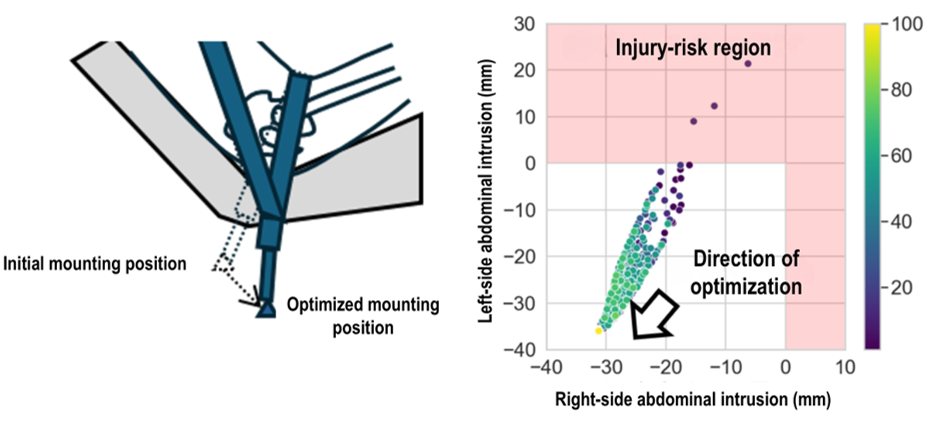
Through GUI-based operations alone, an AI surrogate model with good predictive performance overall was built from only 14 CAE cases and the analysis was carried all the way through to the derivation of the optimal design.
The results demonstrate that combining CAE with AI can make advanced analysis and optimization achievable even for complex design challenges.
This is only one example of the potential of AI surrogate models. In the final section, we will look ahead to how AI may further expand the possibilities of practical engineering design.
6. Future outlook and conclusion
Surrogate models are bringing CAE and AI into a new era of design
Throughout this article, we have explored AI surrogate models as a practical way to overcome the limitations of CAE, together with a case study showing how they can be applied in real design work.
In particular, the introduction of AI surrogate models makes rapid optimization feasible even for computationally intensive analyses. At the same time, no-code AI analytics platforms such as Multi-Sigma® are making it easier for engineers to build and use AI models, even without specialized expertise.
Bringing together the strengths of CAE and AI makes several goals that were once difficult to achieve far more attainable:
- Solving complex Multi-Objective Optimization problems more efficiently
- Optimizing development processes even when resources are limited
- Advancing front-loading by checking performance before building physical prototypes
- Reducing the number of prototypes required, along with the development time and costs associated with them
Future outlook: Making practical AI part of everyday engineering
As surrogate models and related AI technologies continue to advance, engineering design is expected to move away from repeated trial and error and toward a more intelligent process shaped by data and AI.
The scope of application is also likely to expand further, including:
- Optimization across multiple physical domains
- Real-time optimization within digital-twin environments
- The use of AI throughout the entire product lifecycle (from development to operation)
- Stronger supply-chain collaboration through the reuse and sharing of design knowledge
For this transition to take hold, AI must not remain a technology reserved for a small group of specialists. It needs to become a practical tool that engineers can use directly in their own work.
The future of manufacturing through the collaboration of engineering expertise and AI
AI is not a substitute for the creativity or intuition of a skilled designer. Its real value lies in complementing and extending engineering expertise by helping engineers approach design and development with greater creativity and efficiency.
When engineers with deep knowledge of CAE can use AI as a tool, they gain far more freedom to explore. The range of possibilities they can investigate, and the depth to which they can pursue them, can expand to an entirely new level.
No-code AI analytics platforms such as Multi-Sigma® provide a practical technical foundation for engineers in the field, making that first step accessible to anyone.
AIZOTH Inc. has extensive experience and expertise in this area. For further information on developing AI surrogate models, or Reduced Order Models (ROMs), from small datasets, including the approach introduced in this article, please contact AIZOTH’s team.
References
(1) Saito, H. et al. “Understanding the Influence of Seat Belt Geometries on Belt-to-Pelvis Angle Can Help Prevent Submarining,” SAE Int. J. Trans. Safety 10(2):463-481, 2022, https://doi.org/10.4271/09-10-02-0017.






機械学習を使った分析や予測が日常的に行われる今、協調フレームとしてのMulti-Sigma®の役割は増すばかりです。
『どのような場面で活用できるのか』をもっと知りたい方や、実際の利用シーンを見てみたい方は、是非一度お気軽にご相談ください。
In a world where machine learning-based analysis and prediction are becoming everyday practices, the role of Multi-Sigma® as a collaborative framework is more crucial than ever.
If you're interested in learning more about how it can be applied or want to see real-world examples, feel free to contact us.