The AI-Discovered “Golden Ratio” of Tennis Racket Design
How Multi-Sigma® Reveals the Design Formula Behind Winning Performance

Introduction: The “best racket” might be your worst match
Let us begin with a simple question. If you picked up the racket that Federer himself relies on, would you suddenly be able to hit spectacular shots like he does? The answer is probably no. In fact, the racket might be too heavy for you, causing your swing to lag behind the ball. It might be too stiff, placing strain on your wrist instead of helping your game.
In tennis, a racket is not just a piece of equipment. It is almost “an extension of the body”, something that has to move in harmony with the player’s physical ability, technique, and sense of timing. But this is where racket design becomes difficult. Top professionals need razor-sharp control, while beginners need a racket that gives them more margin for error when their timing or technique is not perfect. A racket built for precise control may punish small mistakes. When improving one quality means compromising another, how can we find the “right answer” for each player?
In this blog article, we will introduce a case study showing how Multi-Sigma® uncovered this “golden ratio” through the clear calculations of data and AI, rather than relying only on craftsmen’s experience and intuition.
Training the AI with data from 191 real rackets
The first step in the analysis is to teach the AI what a tennis racket actually is. For this case study, we collected measured specification data for 191 real rackets from Tennis Express ( https://tennisexpress.com ), one of the world’s largest tennis equipment stores.
But this dataset is not just a list of numbers. It can be seen as the “genetic code” of successful products: rackets that have survived in the market and earned the trust of many players over time. Multi-Sigma® learns from this real market data and builds a model of the physical patterns that shape racket performance (in other words, the relationship between design parameters and actual performance).
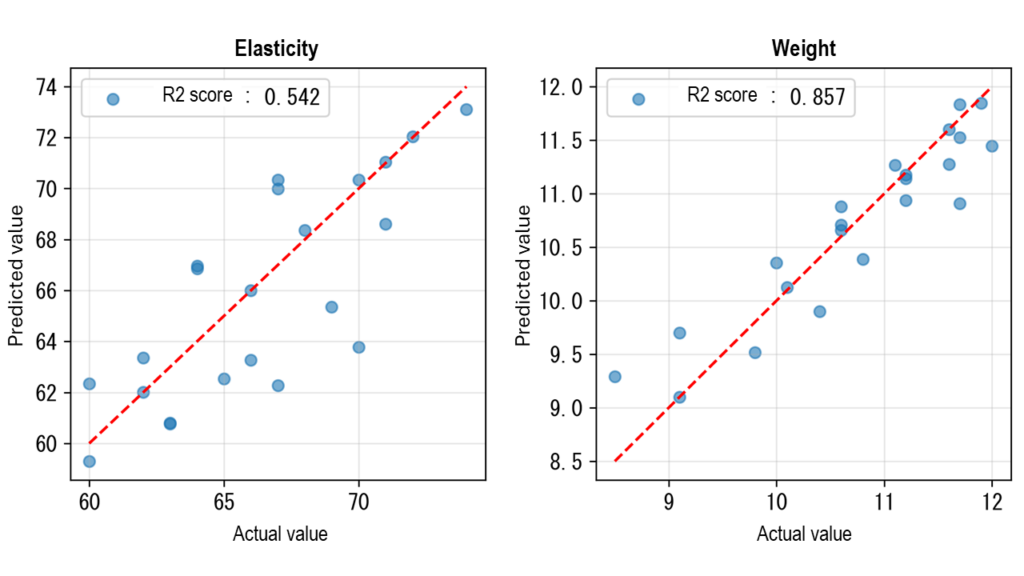
(actual values vs. predicted values)
Real products on the market naturally include individual differences and small manufacturing variations. Even so, as the figure shows, Multi-Sigma® can still capture the underlying physical tendencies that shape racket performance. This means the model is reliable enough to serve as a practical compass when deciding the direction of racket design.
Target setting: Three types of ideal racket
Next, we define the challenge we want the AI to address. Here, we set three different versions of the “ideal rackets”, each matched to a different type of player.
Advanced player (hard hitter)
- Design priority: moderate flex that can handle a powerful swing, and enough weight to hold up against heavy shots
- Target values: elasticity (64.0) × weight (11.89 oz / 337 g)
Beginner
- Design priority: lively rebound that helps the ball travel with less effort, and a light weight that does not quickly lead to fatigue
- Target values: elasticity (72.0) × weight (10.09 oz / 286 g)
Intermediate player
- Design priority: the best of both worlds
- Target values: elasticity (69.0) × weight (10.90 oz / 309 g)
The question is how to combine the racket’s length, head size, balance point (center of gravity), and frame thickness to meet these conflicting requests. For a human designer, this can quickly become a confusing puzzle. For AI, it becomes a problem to address.
Contribution Analysis: How AI turns a craftsman’s “instinct” into numbers
After reading the data, Multi-Sigma® first showed which factors were actually influencing racket performance.
- Elasticity/stiffness: mainly affected by frame thickness and head size
- Weight: mainly affected by frame thickness and length
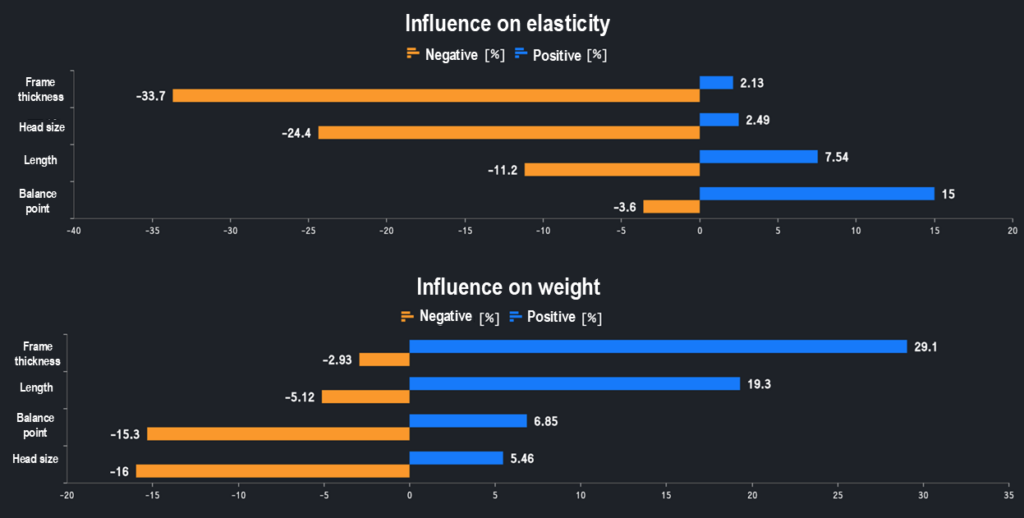
These results make sense from a physical point of view:
- For weight, the logic is simple. If the racket becomes longer, or if the frame becomes thicker, more material is needed. Naturally, the racket becomes heavier.
- For elasticity/stiffness, the results also show that frame thickness and head size are closely tied to the structural rigidity of the racket.
What is important here is not only that Multi-Sigma® identifies these relationships, but that it quantitatively visualizes the contribution of each factor.
A skilled racket designer may already have a feeling for this. They may know from experience that, “if we make the frame a little thicker, the racket will probably become about this much heavier.” That kind of tacit knowledge is extremely valuable, but it is still based on experience and intuition. Multi-Sigma®, on the other hand, captures that relationship quantitatively. In other words, it can handle the complex design equation behind questions such as: “If the frame thickness is increased by 0.1 mm, how many grams will the racket gain, and how will that affect how easy it is to swing in return?”
And since this kind of “quantitative understanding” is available now, the next step becomes possible: optimization at a level that would be extremely difficult for humans to achieve by intuition alone.
Now comes AI-driven design optimization
This is where Multi-Sigma® really comes into its own. Using the model we had built together with a genetic algorithm, we worked backward to find the design values that would come closest to the target values for each player level. In other words, Multi-Sigma® carried out Multi-Objective Optimization.
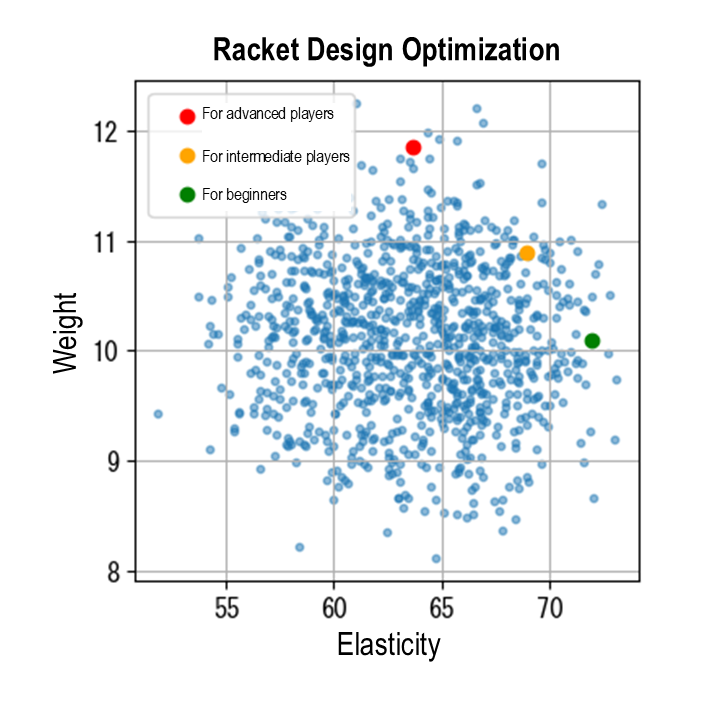
Take a look at the figure above. Among countless possible design combinations, the optimization process identified design candidates that land almost exactly on the target points for each player type: advanced players (in red), intermediate players (in yellow), and beginners (in green).
As a result of the optimization calculation, the following design candidates were obtained, each with an error of less than 0.5% from the target values set in advance.
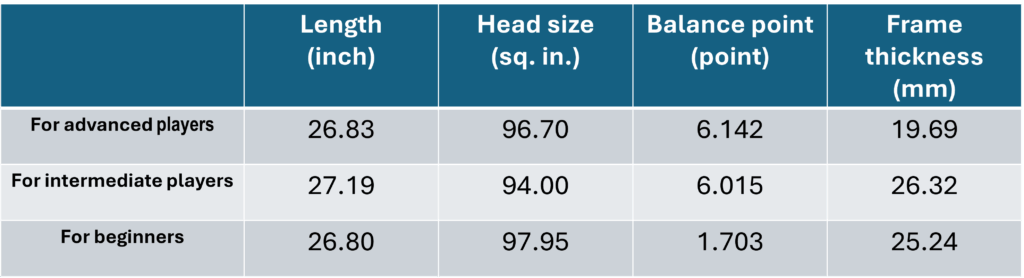
What makes the AI-generated design results so interesting:
- For advanced players: a smaller head size (96.7 sq. in./ 623.87 sq. cm) and a thinner frame (19 mm).
→ A specification close to a true “pro model”, designed to use racket flex for precise ball control. - For beginners: a larger head size (97.95 sq. in./ 631.94 sq. cm) and a thicker frame (25 mm).
→ A specification closer to an “entry model”, where the larger sweet spot and added frame support help compensate for limited power.
What is especially interesting here is the unexpected relationship between shape and weight. From a purely physical point of view, a racket like the advanced-player model, with a smaller head and a thinner frame, should naturally become lighter because it uses less material. Yet the design candidate identified by AI is actually heavy, at 11.89 oz / 337 g, despite its smaller volume.
By contrast, the beginner model has a larger overall shape, but is lighter, at 10.09 oz / 286 g. In other words, the AI has revealed a kind of reversal: the smaller-looking racket is heavier, while the larger-looking racket is lighter!
AI may be capturing more than shape alone
This suggests that AI was not simply solving an equation based on shape. Through real market data, it also captured a pattern that does not appear directly in the specification table: the difference in material density. In other words, it picked up on the fact that thinner rackets designed for advanced players are often made with denser materials. “Small and thin, yet heavy”. At first glance, this may seem strange if we think only about the basic shape and size. But AI was able to reproduce this relationship by connecting two things: the advanced player’s need for enough weight to avoid being overpowered, and the patterns hidden in actual product data.
AI does not “know” physics in the human sense. It has also never played tennis. Yet from the data, it was able to derive a realistic design candidate that reflects even the hidden differences in material density, with a level of precision that begins to approach expert design intuition.
This is what makes the result so interesting. AI is not only matching surface-level dimensions. It is also capturing the practical consistency behind real products. That is why Multi-Sigma® can respond even to niche design requirements that may not yet be well represented in the market. It does not merely force the numbers to fit on paper, but it can quickly draw out a realistic and optimized design direction grounded in the patterns of actual product data.
Conclusion: Shortening the cycle of trial and error in development
What this case study shows is not just a new way to design a tennis racket. It points to something much broader: a shift in the development process itself, with implications for many kinds of manufacturing.
1.Turning tacit knowledge into explicit knowledge: The intuition of experienced engineers and craftsmen can now be made visible through data analysis.
2.Managing multi-objective trade-offs: The familiar problem of “you can’t have your cake and eat it too” (improving one thing at the cost of another) can be approached mathematically.
3.Dramatically reducing development time: Cycles of prototyping and testing that might normally take months can be explored through AI-based simulation.
Lightweight automotive parts, the right balance of ingredients in food products, control over the properties of chemical materials, etc. Every industry faces the same kind of challenge: how to find the “golden ratio” that satisfies several conditions at once.
Instead of wandering through a maze of endless trial and error, development teams can move more directly toward a design direction that makes sense. As a compass for that process, why not bring Multi-Sigma® into your development workflow to make development faster, clearer, and more confident?






機械学習を使った分析や予測が日常的に行われる今、協調フレームとしてのMulti-Sigma®の役割は増すばかりです。
『どのような場面で活用できるのか』をもっと知りたい方や、実際の利用シーンを見てみたい方は、是非一度お気軽にご相談ください。
In a world where machine learning-based analysis and prediction are becoming everyday practices, the role of Multi-Sigma® as a collaborative framework is more crucial than ever.
If you're interested in learning more about how it can be applied or want to see real-world examples, feel free to contact us.