
AIZOTH Inc.’s AI analytics platform, Multi-Sigma®, builds a predictive AI model trained on spot welding conditions and resulting weld performance to optimize robust spot-welding parameters.
1. Building an AI Model with Multi-Sigma®
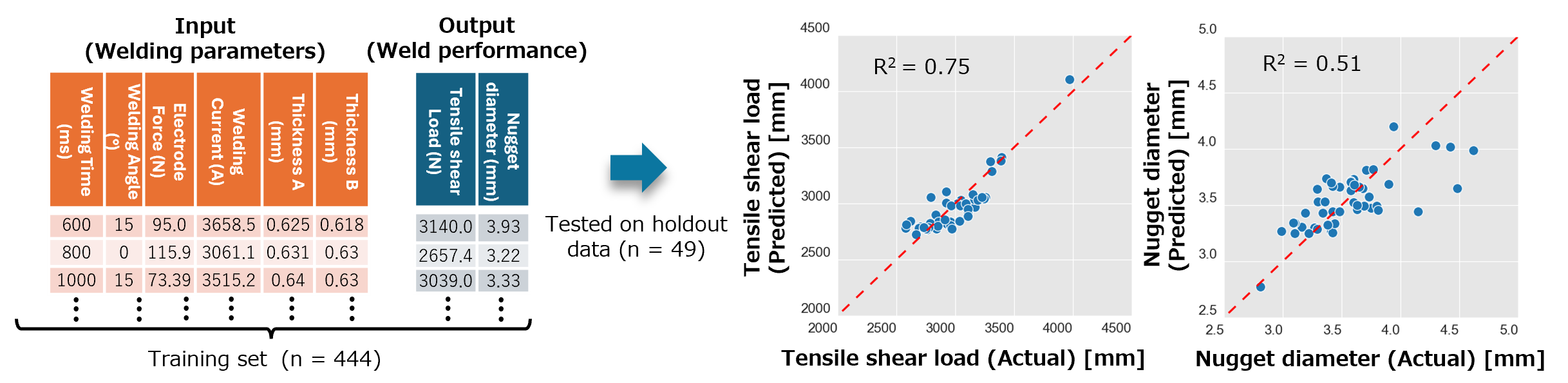
Spot welding data for structural steel was used to train an AI model in Multi-Sigma®. Welding conditions such as electrode force, weld time, and welding current, and sheet thickness were used as input variables, while tensile shear load and nugget diameter (fusion zone size) were used as output targets. The resulting model achieved R² = 0.75 for tensile shear load and R² = 0.51 for nugget diameter.
2. Customized Optimization for Different Thickness Combinations with Multi-Sigma®
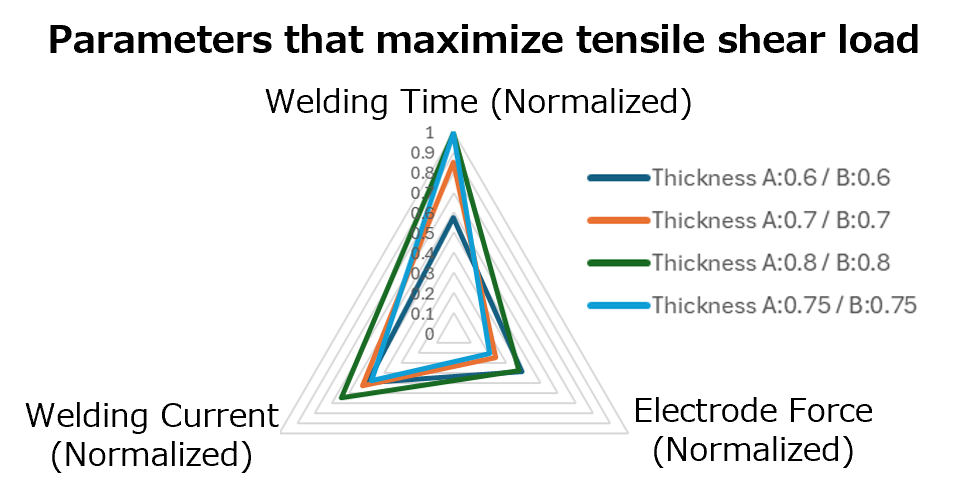
Using the AI model, Multi-Sigma® identifies optimal welding conditions for any sheet-thickness combination using its optimization function. For example, given Thickness A: 0.65 mm and Thickness B: 0.75 mm, it automatically identifies welding conditions that maximize tensile shear load, reducing reliance on conventional trial-and-error efforts.
3. Robust Condition search with Multi-Sigma®
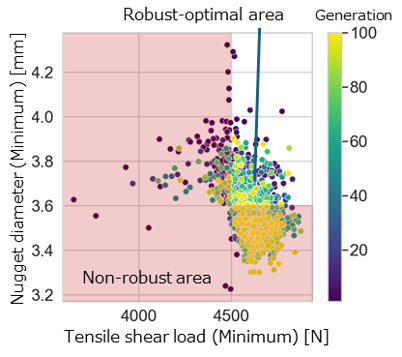
Multi-Sigma® supports robust optimization to handle noise-factor variation. In this study, sheet-thickness variation at the weld interface was treated as a noise factor to represent normal variations form the press-forming process . For Thickness A = 0.9 mm and Thickness B = 0.9 mm with ±3% variation, Multi-Sigma® automatically searches for conditions that satisfy the following performance targets:
- Tensile shear load ≥ 4500 N
- Nugget diameter ≥ 3.6 mm
These robust process conditions enable stable mass production and can be efficiently identified using Multi-Sigma®.
Note 1: The data used in this analysis is processed and edited based on the data published in the article below, under Creative Commons Attribution-ShareAlike 4.0International (CC BY-SA 4.0) license.
Source: Dominguez molina, luis alonso (2025), “Resistance Spot Welding Insights: A Dataset Integrating Process Parameters, Infrared, and Surface Imaging”, Mendeley Data, V3, doi: 10.17632/rwh8kjzdch.3
Note 2: In this case study, the electrode angle was set to 0 deg during optimization.
