
1. Background
Integrated motor and fan design has a direct impact on both energy efficiency and overall product competitiveness. At the same time, it is often a major development challenge because the performance trade-offs involved are complex and closely interconnected. For that reason, being able to shape performance early in the development process through simulation and optimization is increasingly seen as a practical and valuable approach.
2. Data and Methodology
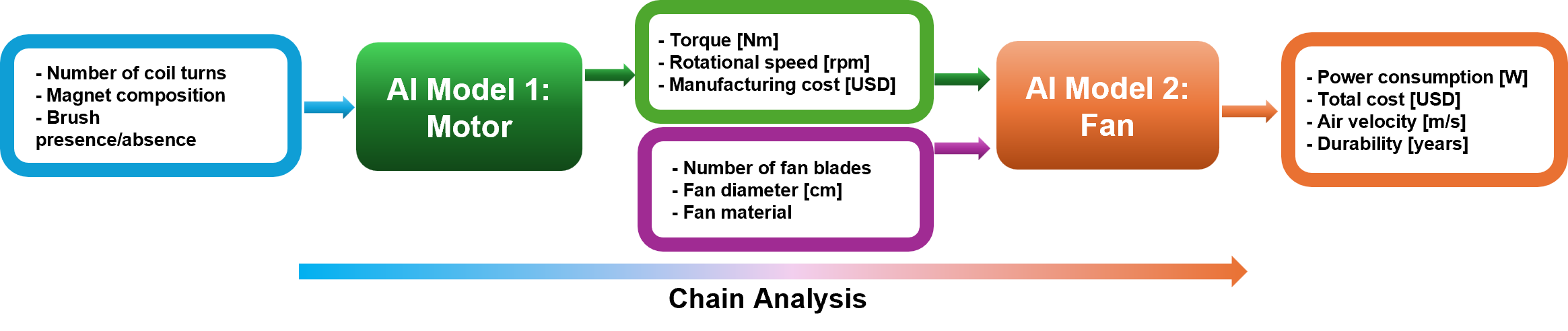
In this analysis, synthetic data representing motor design factors such as coil turns, magnet composition and brush presence, together with fan design factors such as blade count, diameter and material, were used. Categorical variables were converted into numerical form through one-hot encoding, and Multi-Sigma®’s Chain Analysis function was applied. This workflow makes it possible to pass predicted motor-performance outputs to a downstream fan-performance model and examine the behavior of the linked system within the dataset.
3. Prediction and Multi-Objective Optimization
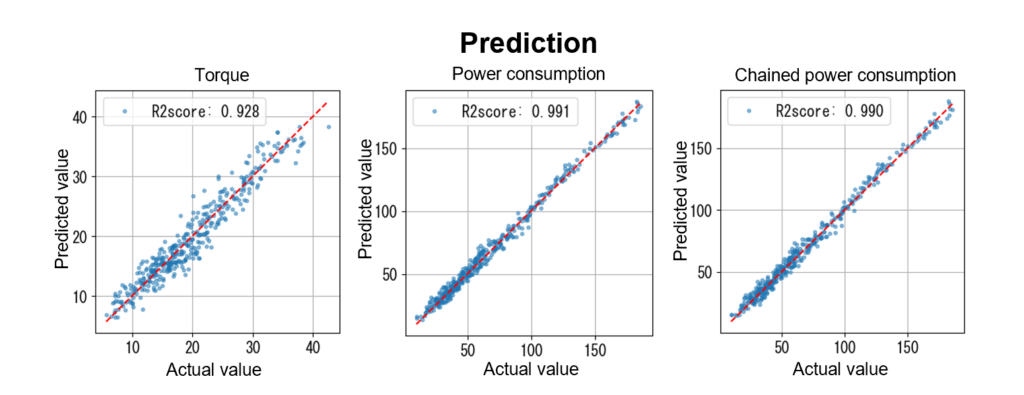
After training with Multi-Sigma®, the motor-only model, the fan-only model and the chained model all showed high predictive accuracy.
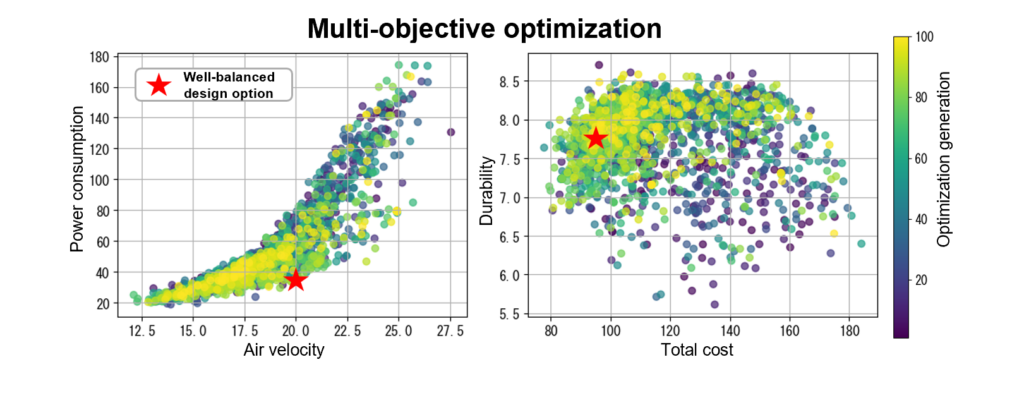
Next, the chained model was used in Multi-Sigma® to run a multi-objective optimization aimed at minimizing power consumption and total cost while maximizing air velocity and durability.
As a result, a well-balanced design option ( ★ ) was identified, offering a strong overall performance trade-off across the objectives, with predicted values of:
- 36.0 W for power consumption,
- 95.5 USD for total cost,
- 20.0 m/s for air velocity,
- and durability of 7.74 years.
4. Conclusion
As this example illustrates, Multi-Sigma® can support the entire development process, from predicting performance to carrying out multi-objective optimization, even for products composed of multiple interdependent components. By making it possible to simulate performance at an early stage and systematically explore promising design directions, it helps teams work more efficiently, uncover better options sooner, and support better product design decisions.
Note: The data used in this analysis is a synthetic dataset created to emulate real-world data.
