
Multi-Sigma® enables fast, AI-driven prediction of ionic conductivity using only composition and basic crystal information. A two-stage surrogate model first predicts key structural and dynamic properties, then estimates ionic conductivity across 18 orders of magnitude. This approach accelerates early-stage screening of solid electrolytes without requiring DFT or molecular dynamics simulations.
1. AI Chain Analysis
Advancing solid-state battery research requires rapid screening of Li-ion conductive materials.
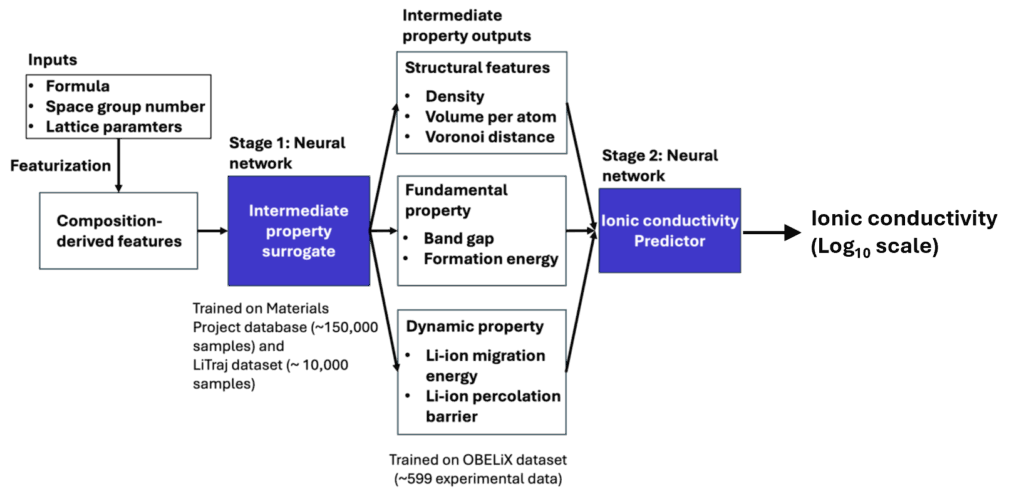
However, experimental ionic conductivity measurements are limited, and DFT/MD simulations are computationally expensive. Multi-Sigma® addresses this challenge using a two-stage surrogate model. The first stage predicts intermediate material properties from composition and crystal data, and the second stage uses these properties to estimate ionic conductivity. This enables large-scale screening of candidate materials without running ab-initio simulations.
Stage 1 uses open material databases to predict key structural, thermodynamic, and ion-transport descriptors from composition and crystal data.
These learned descriptors capture how the lattice environment governs Li-ion mobility.
Stage 2 then uses them to accurately estimate experimental ionic conductivity across 18 orders of magnitude.
2. AI Prediction
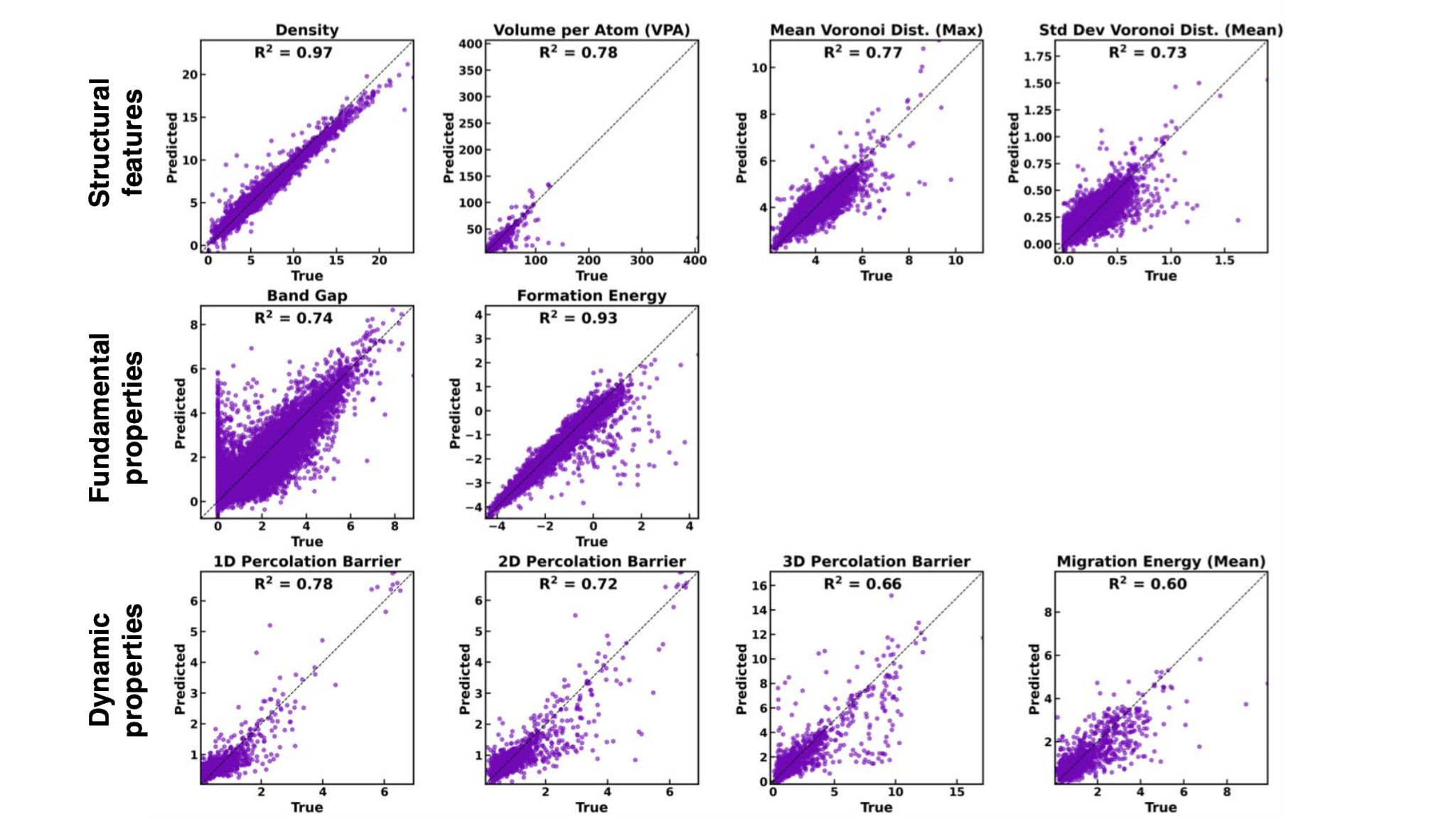
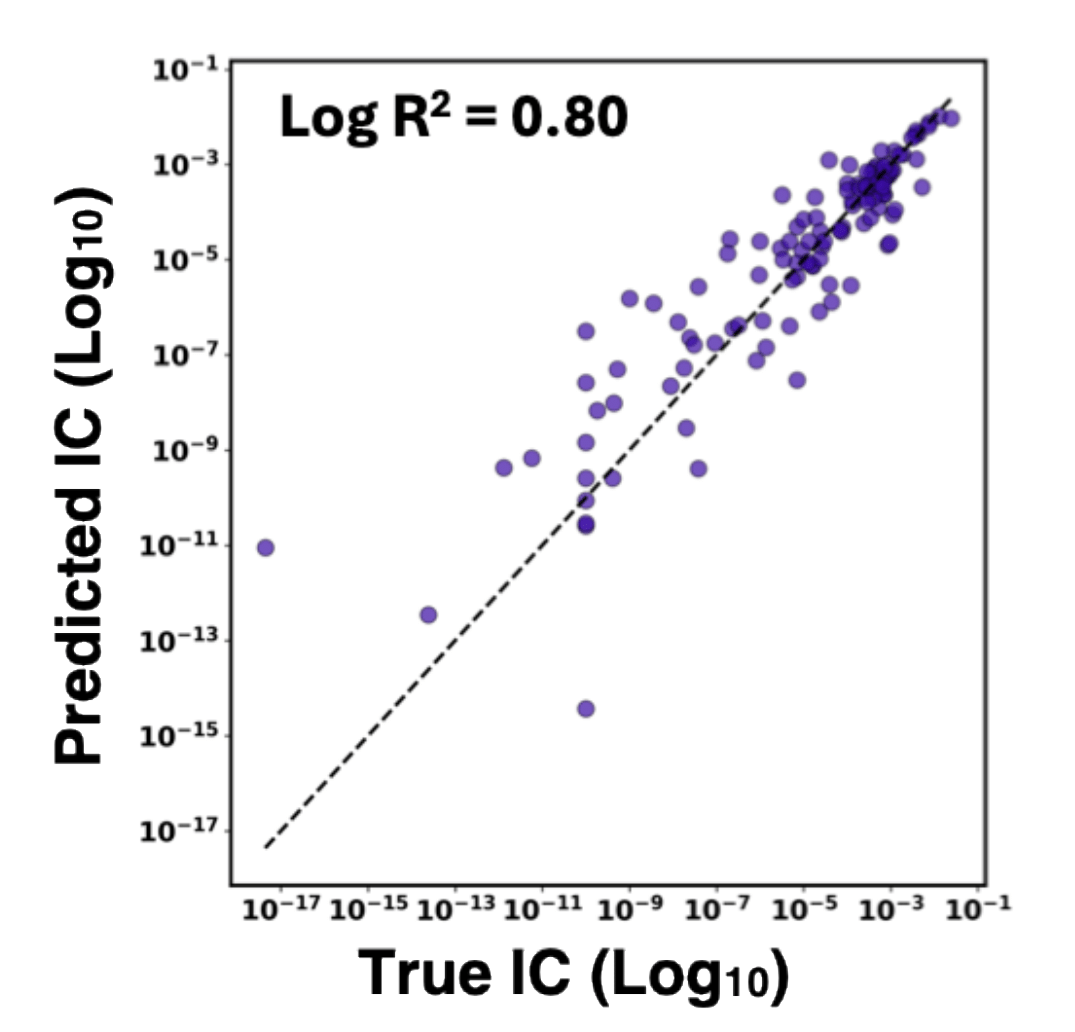
The two-stage model predicts ionic conductivity accurately across 10⁻¹⁷ to 10⁻¹ S/cm. Stage 1 generates transport-relevant descriptors, and Stage 2 uses them to produce conductivity values that align well with experimental data (Log R² = 0.80).
Stage 1: Intermediate property prediction
Stage 2: Ionic conductivity prediction
This usecase is based on results obtained from a project, JPNP23001, commissioned by the New Energy and Industrial Technology Development Organization (NEDO).
Data Source: Rajapriya, N.; Yoshitake, M.; Nagata, T.; Kawajiri, K. Two-stage AI surrogate for predicting ionic conductivity from crystal structure using DFT and topological descriptors. Presented at the ACS Fall 2025 National Meeting & Exposition, Washington, DC, August 19, 2025; COMP Poster Session, Poster 817, Abstract 4308994.
